Volunteering in the Public Service of Tanzania plays a vital role in equipping young graduates with practical skills, work experience, and professional exposure while they await formal employment. Malipo na Posho za Wanaojitolea Serikalini (Payments and Allowances for Government Volunteers).To ensure fairness, transparency, and sustainability of volunteer programs, the Government of Tanzania, through the President’s Office – Public Service Management and Good Governance, issued the Guidelines for Volunteering in the Public Service.
One of the most important aspects addressed in the guideline is payments and allowances for government volunteers. Although volunteers are not employees, the Government recognizes the need to support them financially to enable them to meet basic living costs such as transport and meals. These payments are not salaries but facilitative allowances aimed at enabling volunteers to effectively participate in public service delivery .
Legal and Policy Basis for Volunteer Allowances
Payments and allowances for volunteers are provided in accordance with the Public Service Management and Employment Policy (2008) and the Public Service Act, Chapter 298. The guideline emphasizes that all Public Institutions must plan and budget for volunteer costs before engaging them, in order to avoid disputes and inconsistencies across institutions .
The President’s Office is responsible for setting and periodically reviewing the minimum allowance rates applicable to volunteers in the Public Service.
Types of Payments and Allowances for Government Volunteers
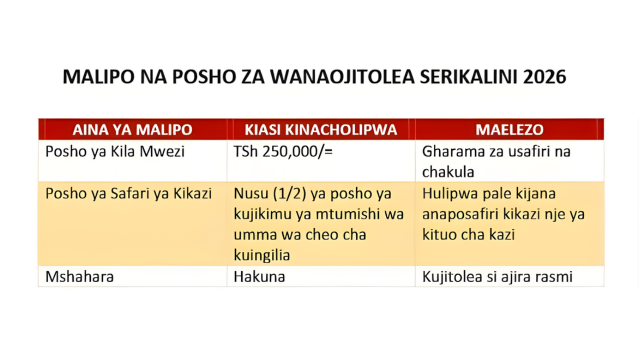
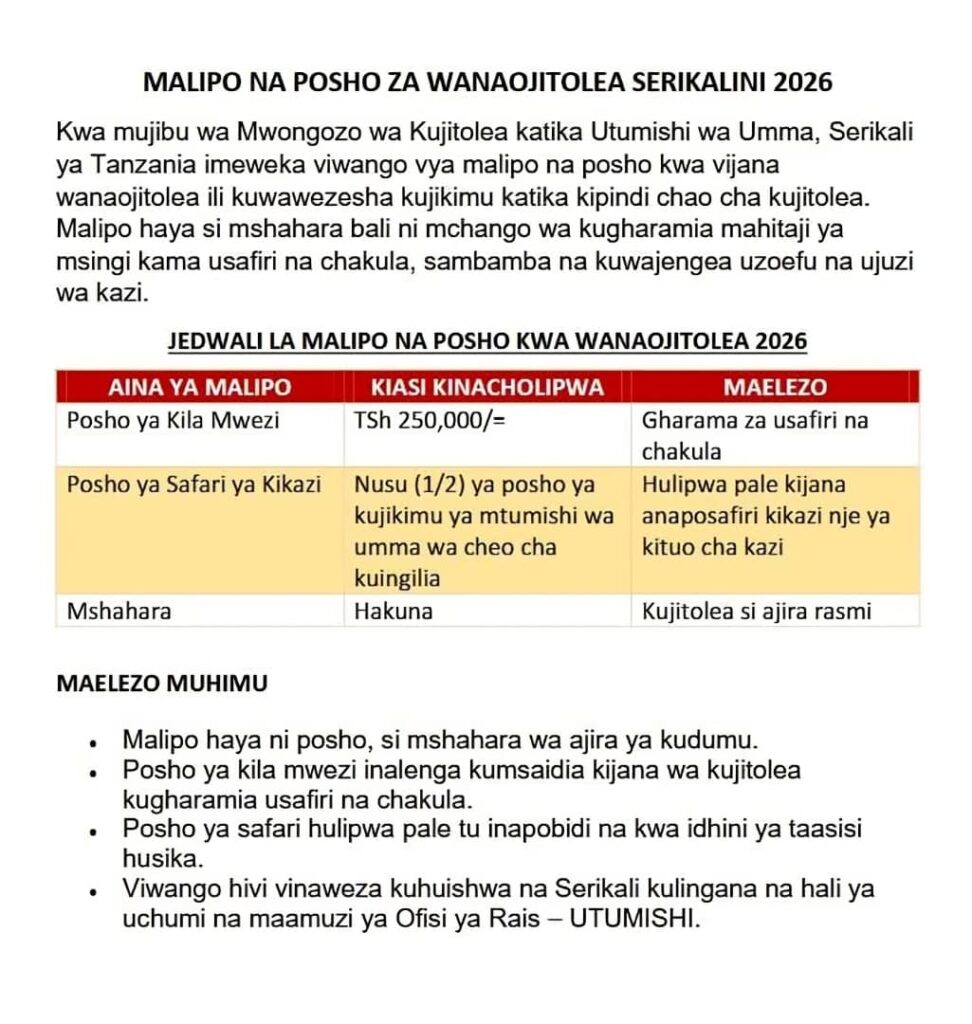
The following table summarizes the official payments and allowances applicable to volunteers serving in Public Institutions in Tanzania, Malipo na Posho za Wanaojitolea Serikalini (Payments and Allowances for Government Volunteers).
Table: Payments and Allowances for Government Volunteers
| S/N | Type of Payment / Allowance | Amount Payable | Description |
|---|---|---|---|
| 1 | Monthly Subsistence Allowance | TZS 250,000 per month | Paid to cover basic living expenses, mainly transport and meals, during the volunteering period. |
| 2 | Travel Allowance (Official Duties) | 50% of entry-level public servant per diem | Paid when a volunteer is required to travel outside their normal duty station for official assignments. |
| 3 | Training and Orientation Support | As determined by the institution | Provided during induction and job-related training sessions, depending on institutional capacity. |
| 4 | Working Tools and Facilities | Not monetary | Includes office space, equipment, and access to ICT systems required to perform assigned duties. |
| 5 | Protective Gear / Uniform (where applicable) | Provided by the institution | Supplied for cadres that require uniforms or protective clothing during service. |
Key Conditions Governing Volunteer Payments
Several important conditions guide the provision of payments and allowances to volunteers:
- Payments are facilitative, not salaries, and do not create an employment relationship.
- Volunteering does not guarantee employment in the Public Service after completion.
- Allowances must be budgeted and approved before volunteers are engaged.
- Monthly payments are subject to satisfactory performance and adherence to public service ethics.
- Allowance rates may be reviewed periodically depending on economic conditions and government directives .
Importance of Standardized Allowances
The introduction of a uniform minimum allowance has helped to:
- Reduce complaints and disparities among volunteers across institutions.
- Improve morale and commitment of young graduates.
- Enhance transparency and good governance in volunteer management.
- Enable wider and fair access to volunteering opportunities in the Public Service.
By supporting volunteers financially, the Government ensures that volunteering remains inclusive and beneficial to both the individual and the nation.
Conclusion
Payments and allowances for government volunteers in Tanzania are a critical component of the national volunteer framework. While volunteering remains a non-employment arrangement, the provision of structured financial support enables young graduates to gain meaningful experience without undue hardship. Public Institutions are therefore required to strictly adhere to the approved guidelines to ensure fairness, accountability, and effective service delivery within the Public Service.